
Planning, Execution and Space: Spatial Audio

Updated: May 17, 2024
This project was an interesting one to work on as me in a group of 5 were asked to plan, setup, record and mix a surround sound mix of the Hetty Buchanan String Quartet, the location being St Andrew's University's Laidlaw Music Centre. This was our process.
The Plan
The Plan wasn't exactly simple, to begin, we first had to decide what kind of microphone techniques and microphones we were gonna use. we had a few ideas, Namely OCT, Decca tree, Hamasaki Tree and IRT Cross. to decide, we had a few sessions setting up different combinations of microphone placements to decide which one's we wanted to use
Decision one: OCT + Hamasaki Square
OCT Seemed appealing, However Hamasaki Square seemed, while an interesting option, didn't feel like the correct choice to coincide with OCT, with it's larger area and omnidirectional mics, it did not feel like OCT and Hamasaki Square would work well together in the environment

Decision two: Decca Tree
Decca Tree as a full Front and Ambiant Array seemed ideal, easy to set up, all mics coincide with eachother, and of course, would definitely work alongside eachother, however, looking at the stage layout, this setup would simply be too large to work

Decision three: OCT + IRT
OCT + IRT, the choice we ended up picking, this was because it had the best of both worlds, it was compact, allowing for setup in any kind of stage, it was easy to setup, allowing for fast setup times and all mics would be the same, meaning they'd function well together. it all seemed perfect for the space we were in.


Next, Floor Plan, once we decided what microphones we were going to use, the next thing would be coming up with a floor plan, getting the stage layout alongside where the performers will be, it would be useful to get a floor plan done, it makes placement far easier and faster for setup
Here is my completed floor plan


One shows the placement, distance apart of mics, altitude, and angle of the microphones, the other shows the wire setup
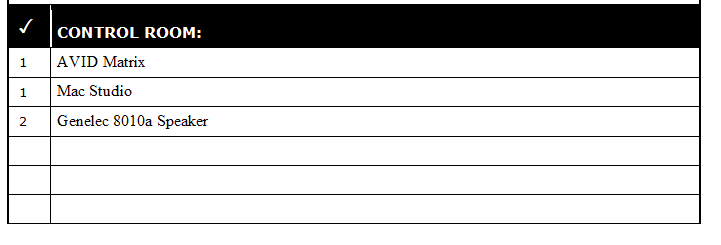
Next we had to create an equipment list and input list, that way we knew exactly what to bring, how much of it to bring, and where each mic would plug in
Here is the equipment list and input list

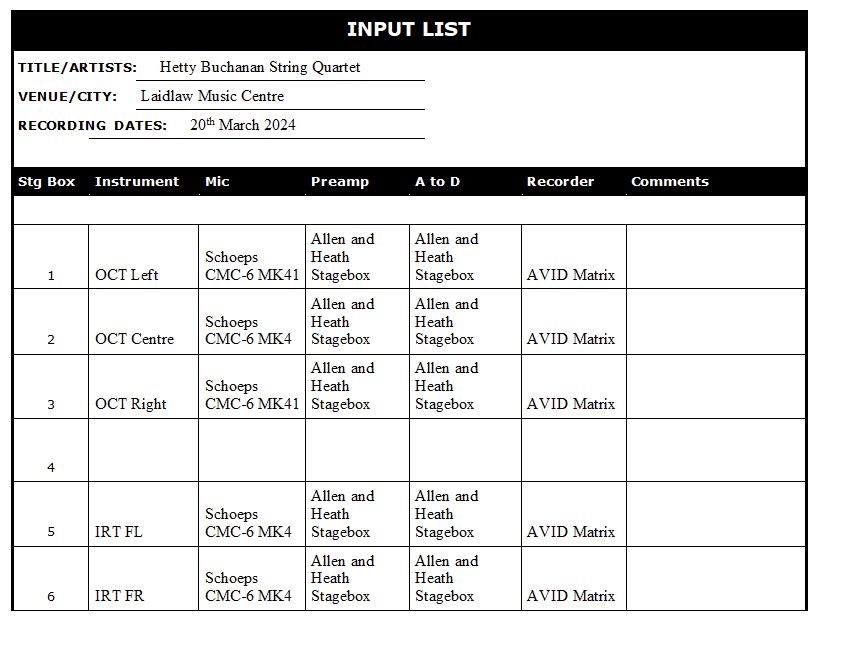

We decided upon the Schoeps CMC 6 microphones were good for the job, as we could use them for each mic, the mic capsules made them easy to switch polar patterns and have replacements if the capsules were to be malfunctioning and their even frequency response made it ideal to pick up a string quartet, which had instruments which varied through the entire frequency spectrum


The Setup
Setting up in a timed environment can go one of two ways, smoothly, or horribly, it all depends on how coordinated you are to the plan. to begin, we had to collect everything from the equipment list, loading it into the vehicle we used to transport the equipment.
Once we made it onto location, we brought all the equipment out and into the backstage area, where we immediately began to setup the OCT, due to it all being in one stand, it is the easiest to set up and roll in before hand, setting up the IRT would be a more divided job, only being able to put up the Stereo Bars until the time came to put the equipment onto the stage
When we had to start putting stuff on the stage, we had to hurry to place everything in its corresponding locations on the floor plan, place the mics onto their clips and plug them in before raising the OCT up to its altitude, making sure the microphones do not move by wrapping the cables around the mic stand.


Measuring the angles for IRT was the most stressful part, With the limited time, it had to be correct, but we couldn't take long to do so, once that part was completed, we had to wire it over, taping the cables to the floor to conceal them and remove tripping hazards, and then plugging them into the locations of the input list.

Once both were setup and properly secured, we could plug the cables into the stagebox in their correct locations

The Recording
Recording was a simple process, we had to simply keep things from getting too loud while they're playing, predicting which instruments may peak and subtly reducing the gain, having a conductor beside us guiding the recording while the string quartet played
The Teardown
The Teardown was another quick process, having to be careful with the sequence, making sure the stagebox was off before unplugging all the XLR Cables, carefully bringing down the mic stand to be able to safely remove the microphones before tearing the rest of the equipment down, the key here is safety, whenever handling important equipment that can be easily damaged, be extremely careful and make sure everything is done in order to make sure no damage is done.
The Setup (Part 2)
when setting up the speakers for a surround sound room, its important to keep your own position in mind, and keeping that position the same at all times.
the main rules to follow, all left and right speakers are around 5 metres away from your head and facing your head, that way all the sound is coming out from the exact same distance and reaching your head at the same time.

use a signal generator to test the loudness of each speaker, some people may put gain gates or volume trims on your speakers, it's important to check beforehand in case this happens.

when you find the location you've placed yourself at (directly infront of the centre speaker), you can then mark the spot and then setup the speakers
The Mixing
The Mixing consisted of mainly comping different takes, as the microphones experienced clipping and glitching, finding different takes and placing them in the exact correct location was a struggle at first, yet finding a strategy of using grid mode so they would always align ended up working in my favour.

Then I had to make a simple mix, adjusting the gain on each track to make an equal and satisfying listen where you can hear the audio from all around you by panning each track to where each corresponding speaker would be (OCT Left and Right would be the front left and right speakers, while the rear left and right of IRT would be the rear left and right speakers)

(Me panning the OCT Left Track)
Then, for an extremely subtle change, i used time adjuster to adjust the spot microphones from the OCT by 279 samples, the amount of samples that is the 2 metre distance between both microphones.

In conclusion, it could have gone better, while the planning was fine enough, we neglected certain things like making sure the cables were fully plugged in. which is what we think caused the clipping of the microphones. however, the mixing part, while a good challenge, was a great experience in comping, panning and using a plugin i've never used before.


Comments